


 PLATFORM UPDATE:


Contrasting mechanisms of UDMH degradation by MnO2 and Mn2O3 under microwave assistance: electronic structure, surface adsorption and catalytic reaction pathways

Abstract
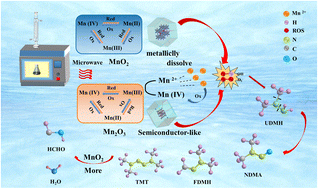
Unsymmetrical dimethylhydrazine (UDMH) is difficult to efficiently degrade and mineralize using traditional wastewater treatment processes, leading to the accumulation of toxic nitrogenous intermediates. In this study, a microwave-assisted catalytic degradation system based on manganese oxides was developed for effective UDMH treatment. Experiments were integrated with DFT calculations to systematically compare the structure–activity relationships of MnO2 and Mn2O3. DFT calculations show that the metallic character of Mn2O3 affords high electron mobility that favors rapid reduction of intermediates, whereas semiconducting MnO2 exhibits superior overall catalytic performance; the latter's lower oxygen-vacancy formation energy (2.10 eV vs. 2.41 eV) markedly decreases the barrier for the *OH → *O → *OOH sequence, intensifying oxidative pathways. DFT results, corroborated by XPS and XRD analyses, reveal that both oxides generate ˙OH via dynamic Mn4+/Mn3+/Mn2+ redox cycling and surface hydroxyl enrichment. However, MnO2, exhibiting higher surface ˙OH density and lower UDMH adsorption energy, leverages microwave-induced hot spots to sustain ˙OH production, achieving >90% COD removal. Mn2O3 suffers from structural deactivation that constrains long-term stability. The microwave-enhanced mechanism of Mn-based catalysis was elucidated by the three-scale analysis—electronic structure, surface adsorption and catalytic reaction. This study provides a theoretical basis for the design of manganese-based catalysts and supports their applications in the microwave-assisted treatment of nitrogen-containing wastewater.
 Please wait while we load your content...


