


 PLATFORM UPDATE:


A review from fullerene dominance to non-fullerene innovation: theoretical perspective on next-generation organic photovoltaics

Abstract
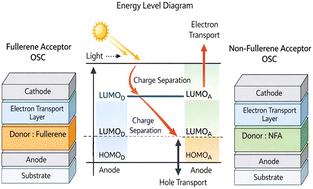
The mechanical flexibility, solution processability, and the capability for low-cost processing of organic photovoltaics (OPVs) make them a viable class of next-generation solar energy technology. The design of effective electron acceptors that promote exciton dissociation, charge transfer, and long-term device stability is a key feature in finding OPV performance. With a focus on their electronic structure, charge-transfer mechanisms, and structure–property connections, this analysis offers theoretical insights into the fabrication of electron acceptors from traditional fullerene derivatives to sophisticated non-fullerene acceptors (NFAs). The creation of NFAs has been fueled by the restricted tunability, weak visible absorption, and morphological instability of fullerene-based acceptors, which have previously dominated because of their suitable energy levels and isotropic charge transmission. Studies using density functional theory (DFT) and time-dependent DFT (TD-DFT) show how end-group engineering, frontier orbital distribution, and molecule geometry in NFAs improve charge mobility, exciton separation, and light absorption. Additionally, theoretical models demonstrate how important molecular planarity, π–π stacking, and dipole moments are in controlling donor–acceptor interfacial energetics and blend morphogenesis. When taken as a whole, these computational insights offer a basic framework for the logical development of next-generation acceptors targeted at increased photostability, lower energy losses, and higher power conversion efficiencies in OPVs.
- This article is part of the themed collection: 2026 Reviews in RSC Advances
 Please wait while we load your content...


