


 PLATFORM UPDATE:


The environmental degradation of naphthalimide, rhodamine and BODIPY fluorophores by hydroxyl radicals: a theoretical insight
 c
Nguyen Minh
Thong,
b
Adam
Mechler,
d
Pham Cam
Nam,
e
Nguyen Khoa
Hien,
f
Quan V.
Vo
*a
c
Nguyen Minh
Thong,
b
Adam
Mechler,
d
Pham Cam
Nam,
e
Nguyen Khoa
Hien,
f
Quan V.
Vo
*a
Abstract
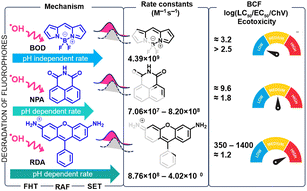
Rhodamine (RDA), naphthalimide (NPA), and BODIPY (BOD) are widely used fluorophores whose environmental fate is hitherto unexplored. In this study, quantum chemical calculations were employed to investigate the HO˙-driven degradation processes of these fluorophores in aqueous and organic media, focusing on the mechanism, kinetics, thermodynamics, and ecological risks. The results suggest that all three fluorophores undergo reactions with HO˙, but their behaviors differ markedly. RDA displays strong pH-dependent reactivity, with overall rate constants ranging from 8.76 × 10⁸ to 4.02 × 10¹⁰ M−1 s−1 depending on protonation state, and lifetimes spanning from hours to years in natural waters. NPA degrades more slowly, with rate constants of 7.06 × 10⁷ M−1 s−1 (neutral form) and 8.20 × 10⁸ M−1 s−1 (anion), resulting in greater environmental persistence. BOD reacts rapidly across all conditions (4.39 × 10⁹ M−1 s−1) consistently via RAF mechanism. Temperature and solvent polarity also influence degradation: higher temperatures accelerate all reactions, and methanol enhances reactivity, while lipid-like media reduce degradation rates for RDA and NPA but not for BOD. NPA, RAD and these intermediates are predicted to exhibit high ecological toxicity (log LC50/EC50/ChV < 2), poor biodegradability, and high bioaccumulation potential, while BOD and its products may be comparatively benign. Overall, the hazard ranking is predicted to be RDA ≈ NPA > BOD, with RDA posing the highest long-term ecological risk. These findings highlight the need to evaluate not only degradation efficiency but also the toxicity and environmental fate of intermediates when applying advanced oxidation processes for fluorophore removal.
 Please wait while we load your content...


