


 PLATFORM UPDATE:


Environmentally friendly fluorescence platform for detection of tetracycline in pharmaceutical formulations and human serums based on highly fluorescent 1,4-di-2-(5-phenyloxazolyl)-benzene
 *a
and
Wrya O.
Karim
a
*a
and
Wrya O.
Karim
a
Abstract
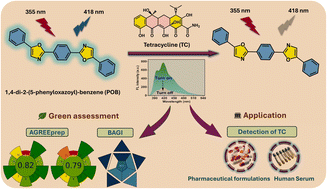
Tetracycline (TC) is an efficient antibiotic used for curing different bacterial infections in both humans and animals. Accurate and precise detection of TC is a requisite for quality control of pharmaceutical productions and patient safety using a reliable method. This study presents a highly sensitive and selective strategy based on utilizing 1,4-di-2-(5-phenyloxazolyl)-benzene (POB) as a molecular fluorescence sensor for detecting TC. POB displays an optimal excitation and a high-intensity emission at 355 nm and 418 nm, respectively. The TC–POB interaction leads to a remarkable quenching of the fluorescence, allowing fluorometric detection of TC. A linear calibration curve in a range of 0.5–40 µM along with a limit of detection (LOD) of 0.143 µM was established. The analytical applicability of the developed method was estimated for measuring TC within pharmaceutical formulations and human serum samples, revealing high accuracy and precision. Ultimately, the greenness of the proposed method was inspected via the Analytical Greenness Metrics for Sample Preparation (AGREEprep) and the Analytical Greenness Index (BAGI), emphasizing the eco-friendly feature with respect to sample preparation steps, applicability, and practicability.
 Please wait while we load your content...


