


 PLATFORM UPDATE:

Dual-ligand surface engineering of Ni-based nanostructures for efficient urea electrooxidation via Ni3+ activation and charge-transfer modulation

Abstract
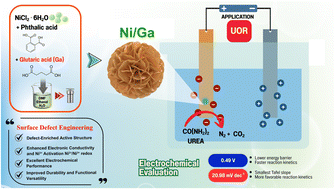
Nickel-based metallic nanomaterials represent highly promising electrocatalysts for the urea oxidation reaction (UOR), enabling the simultaneous benefits of efficient hydrogen production and wastewater treatment. However, their catalytic performance is constrained by slow interfacial charge transfer and insufficient exposure of active Ni3+ sites. Herein, we propose a dual-ligand surface modification strategy employing glutaric acid (Ga) and ferrocenecarboxylic acid (Fc) as co-modifiers alongside phthalic acid as the primary linker, simultaneously optimising the geometric structure and electronic state of the nickel-based catalyst. The optimally modified nickel-based catalyst exhibits a rich array of surface defect morphologies, and XPS analysis confirms that under this modification scheme, the material's specific surface area increases moderately (71.3 m2 g−1), with a marked enhancement in the Ni3+/Ni2+ ratio. These characteristics effectively accelerate the Ni3+/Ni2+ redox conversion and promote the formation of the key active intermediate NiOOH, thereby achieving a low onset potential (0.49 V vs. SCE), minimal Tafel slope (20.98 mV dec−1), and excellent electrochemical durability. Electrochemical impedance and comparative analyses further reveal that glutaric acid-induced surface structural disorder is the dominant factor enhancing interfacial charge transfer. This study presents a ligand-directed surface engineering approach to construct defect-rich nickel-based electrocatalysts with high intrinsic activity, providing a novel technological pathway for sustainable hydrogen production and the resource recovery of urea-containing wastewater.
 Please wait while we load your content...


