


 PLATFORM UPDATE:


Phytochemical profiling of Euphorbia tirucalli Linn. latex and evaluation of its in vitro antibacterial activity against resistant Klebsiella pneumoniae: an integrative network pharmacology and molecular dynamics simulation study
 †ab
Ruqaiah I.
Bedaiwi,
f
Hesham A.
Abou-Zied,
g
Mostafa E.
Rateb
h
and
Usama Ramadan
Abdelmohsen
*ij
†ab
Ruqaiah I.
Bedaiwi,
f
Hesham A.
Abou-Zied,
g
Mostafa E.
Rateb
h
and
Usama Ramadan
Abdelmohsen
*ij
Abstract
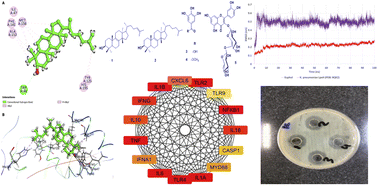
A phytochemical investigation of Euphorbia tirucalli Linn. (F. Euphorbiaceae) latex resulted in the isolation of five known compounds, namely euphol (1), euph-8-enol (2), gallic acid (3), methyl gallate (4), and rutin (5). The chemical structures of the isolated compounds were unambiguously established by extensive nuclear magnetic resonance (NMR) spectroscopic analysis. The antimicrobial activities of these compounds were evaluated against Klebsiella pneumoniae (ATCC 13883), extended-spectrum β-lactamase (ESBL)-producing K. pneumoniae, and carbapenem-resistant K. pneumoniae using the microbroth dilution method. Among the tested compounds, methyl gallate (4) exhibited the strongest activity against K. pneumoniae (ATCC 13883) with a minimum inhibitory concentration (MIC) of 0.01 mM, while euphol (1) showed the highest activity against ESBL K. pneumoniae (MIC = 13.12 mM). Notably, euph-8-enol (2) demonstrated the most potent inhibitory effect against carbapenem-resistant K. pneumoniae, with an MIC of 0.69 mM. Network analysis identified 33 host-response targets relevant to Klebsiella infection, enriched in pattern-recognition receptor signaling and inflammatory defense programs, particularly the Toll-like receptor and NOD-like pathways, alongside cytokine/chemokine-mediated recruitment and inflammasome-associated signaling. Molecular docking against Klebsiella pneumoniae LpxH (PDB: 8QK2) showed the strongest predicted affinity for euphol (1) (−8.13 kcal mol−1). MD simulation of the euphol (1)-LpxH complex over 100 ns supported overall system stability, evidenced by a stable protein backbone RMSD, maintained compactness (Rg), equilibrated potential energy, and intermittent hydrogen bonding consistent with predominantly hydrophobic binding. Collectively, these findings suggested that E. tirucalli, with euphol as the top-ranked binder, could provide structural starting points for further investigation for anti-Klebsiella development, warranting further in vitro validation of LpxH inhibition and antibacterial efficacy against resistant Klebsiella strains.
 Please wait while we load your content...


