


 PLATFORM UPDATE:


Electron transport (0.2 eV–10 keV) in liquid water: resolving discrepancies between track simulations and radiolysis data
 ab
ab
Abstract
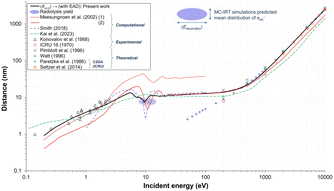
The scattering and transport processes of electrons with initial kinetic energies ranging from 0.2 eV to 10 keV in liquid-phase water are studied using a Monte Carlo (MC) simulation. This study aims to identify a set of scattering cross sections and physical assumptions regarding angular deflection and energy loss that ensure computational results align with available data across the entire energy range of interest. These data include thermalization distances derived from photoinjection measurements in the very low energy regime (<2.5 eV) and theoretical approximations, including continuously slowing down approximation (CSDA) values, up to 10 keV. In particular, incorporating an assumption for track termination events—such as transient negative anion (TNA) formation at resonance peaks followed by dissociative electron attachment (DEA) processes—may resolve the longstanding discrepancy in geminate separation distance of secondary electrons, which has been reported to vary over the rather broad range of 6–14 nm. This discrepancy arises between stochastic models fitted to diffusive spur recombination data from radiolysis measurements and those directly calculated using MC track simulations with measured scattering cross sections. By accounting for secondary electron tracks and electron autodetachment (EAD) from TNA states, as well as autoionization of neutral excited water molecules, the model also reproduces the reported G-value of pre-solvated electrons.
 Please wait while we load your content...


