


 PLATFORM UPDATE:


Structural, linear, and nonlinear optical properties of ortho-carboranyl luminophores: insights from DFT and TD-DFT studies
 ab
Douniazed
Hannachi,
*cd
Meriem
Zaidi,
de
Guillaume
Hoffmann
f
and
Henry
Chermette
*f
ab
Douniazed
Hannachi,
*cd
Meriem
Zaidi,
de
Guillaume
Hoffmann
f
and
Henry
Chermette
*f
Abstract
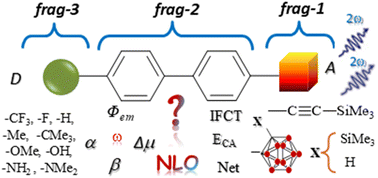
Three non-centrosymmetric molecular series, namely, iM, iH, and iC, are systematically investigated, each incorporating a donor fragment substituted with various functional groups (R = –CF3, –F, –H, –CH3, –tBu, –OMe, –OH, –NH2, and –NMe2) and differing in the nature of the electron-accepting core, with a trimethylsilyl-acetylene unit in iM, an o-carborane cage in iH, and a trimethylsilyl-functionalized o-carborane cage in iC. The geometries of the ground and first excited states, the absorption and emission electronic transitions, and intrafragment charge transfer are fully characterized using DFT and TD-DFT methods. Furthermore, first- and second-order NLO responses are examined under both static and dynamic regimes. The results show that the iC derivatives exhibit slightly higher variations in dipole moment (Δµ), oscillator strength (f), Coulomb attractive energy (ECA), net electron transfer between the substituent (R) and the o-carborane cage, Stokes shift, and NLO responses compared with the corresponding iH derivatives. In contrast, the iM molecules display consistently lower values for these parameters. For all series, the magnitude of these properties increases with the electron-donor strength of the R group, with the iC series showing an ∼854% rise in β0 from 1C to 9C. A strong correlation is observed between the first hyperpolarizability and both the net electron transfer between fragments (1 → 3) (R2 > 0.97) and the Coulomb attractive energy of iH and iC (R2 > 0.95). For the iC compounds (i = 2–6), an excellent linear relationship is also found between the photoluminescence quantum yield (Φem) and the static first hyperpolarizability (R2 = 0.92). Notably, the o-carborane derivatives bearing an –NMe2 substituent demonstrate the potential to serve as highly efficient second-order NLO materials.
 Please wait while we load your content...


