Issue 22, 2026, Issue in Progress

Photophysical studies of diazines: effects of solvents and complexation with Cu2+, Ni2+, Co2+ and Pb2+ ions

Abstract

The detection of toxic metal ions, such as Pb2+, has become important because they cause several health issues. This study describes the photophysical properties displayed by a few symmetrical diazine compounds and the influence of solvent polarity on their emission spectra. It is noted that λem increases with an increase in the polarity of the solvent. The study of the complexation of diazine compounds with metal ions, such as Cu2+, Ni2+, Co2+ and Pb2+, shows that the coordination of the metal ions to the diazine molecule induces a blue shift in the UV-visible absorption spectrum. Among the studied compounds, compound 1 exhibited the maximum emission (λem) in hexane at 309 nm, with a maximum quantum yield (Φem) of 0.0576. The metal interaction study shows that the absorption intensity of compound 1 reached the maximum for Pb, indicating that the synthesized diazine could serve as a potential molecule to detect Pb2+ ions. The experimental results were further supported by computational studies, and the experimental data were in good agreement with the theoretical data. The TDDFT study shows that for all the compounds, the λabs corresponds to the HOMO−1 to LUMO+1 transition.
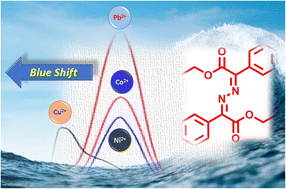
Graphical abstract: Photophysical studies of diazines: effects of solvents and complexation with Cu2+, Ni2+, Co2+ and Pb2+ ions

Supplementary files

Article information

Article type
Paper
Submitted
24 Jan 2026
Accepted
27 Mar 2026
First published
17 Apr 2026
This article is Open Access
Creative Commons BY-NC license

RSC Adv., 2026,16, 19885-19894

Photophysical studies of diazines: effects of solvents and complexation with Cu2+, Ni2+, Co2+ and Pb2+ ions

P. K. Madarasi and C. Sivasankar, RSC Adv., 2026, 16, 19885 DOI: 10.1039/D6RA00637J

This article is licensed under a Creative Commons Attribution-NonCommercial 3.0 Unported Licence. You can use material from this article in other publications, without requesting further permission from the RSC, provided that the correct acknowledgement is given and it is not used for commercial purposes.

To request permission to reproduce material from this article in a commercial publication, please go to the Copyright Clearance Center request page.

If you are an author contributing to an RSC publication, you do not need to request permission provided correct acknowledgement is given.

If you are the author of this article, you do not need to request permission to reproduce figures and diagrams provided correct acknowledgement is given. If you want to reproduce the whole article in a third-party commercial publication (excluding your thesis/dissertation for which permission is not required) please go to the Copyright Clearance Center request page.

Read more about how to correctly acknowledge RSC content.

Social activity

Spotlight

Advertisements