


 PLATFORM UPDATE:


A green and facile modification of red mud waste with MIL-100 (Fe) for multi-pollutant adsorption from wastewater: isotherms, kinetics, and thermodynamics

Abstract
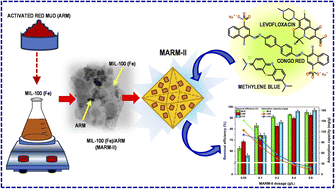
The expansion of the textile and pharmaceutical industries, driven by rapid population growth and evolving lifestyles, has led to an increased release of synthetic chemicals into the environmental matrices, thereby posing risks to aquatic ecosystems and human health. A novel composite adsorbent, fabricated by integrating thermally activated red mud (ARM) with MIL-100 (Fe) (referred to as MARM) via co-precipitation, was utilized for the adsorptive removal of methylene blue (MLB), Congo red (CNR), and levofloxacin (LVX) from an aqueous solution. The assessment of textural properties showed MARM-II (containing 40% MIL-100 Fe) with a high specific surface area (SSA) of 651.741 m2 g−1. The enhanced SSA and distinctive surface charge profile of MARM-II promoted the effective adsorption of MLB, CNR, and LVX onto the MARM-II surface. At optimal conditions (contact time: 150 min, initial MLB, CNR, and LVX concentration: 10 mg L−1 each, MARM-II dose: 0.4 g L−1, solution pH: 7, and temperature: 27 ± 3 °C), MLB, CNR, and LVX removals were recorded to be 93.077 ± 0.593%, 89.739 ± 1.119%, and 96.102 ± 0.997%, respectively. The pseudo-second-order kinetic model confirmed chemisorption was the governing mechanism, while the Sips isotherm best explained the adsorptive nature of MLB, CNR, and LVX on the surface of MARM-II composite. The maximum adsorption capacity for MLB, CNR, and LVX was found to be 123.021 ± 11.926, 143.934 ± 24.248, and 97.657 ± 5.686 mg g−1, respectively. Additionally, the thermodynamic investigation indicates that the adsorption process was characterized as exothermic and spontaneous. The mechanistic insights showcased that the adsorption process was mainly driven by electrostatic interaction, hydrogen bonding, π–π interaction, and chemisorption.
 Please wait while we load your content...


