


 PLATFORM UPDATE:


Direct laser writing of black metals for tuneable plasmonic nanoparticles: experimental and computational insights

Abstract
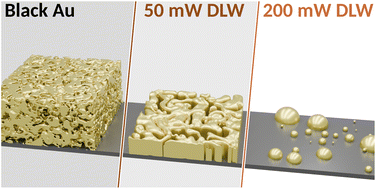
Plasmonic nanoparticles, recognized for their light-absorbing qualities, show significant potential in many optical applications including nanophotonics and sensors. However, their widespread use is often limited by the high cost associated with manufacturing processes. In this study, we introduce an accessible and cost-effective approach to produce plasmonic nanoparticles. We employ a straightforward direct laser writing method, utilizing a common 405 nm continuous-wave laser diode, on nanostructured black metal films that can readily melt to produce spherical nanoparticles. By adjusting the laser power, we can control the size of these particles and arrange them in patterns on the black metal films. Subsequently, the optical properties of the nanoparticles are characterized and the experimental data are related with those obtained by computational simulations. The analysis indicates that two separate particle populations are formed during laser writing. The analysis attributes the observed absorption peak to plasmonic resonances in the particles population with smaller diameter. The formation of the particles is controlled by the writing laser power, affecting size and shape distribution of the particles, and subsequently—plasmonic resonances. This approach holds the potential to enable the economical production of plasmonic nanoparticles, which could have broad applications.
 Please wait while we load your content...


