


 PLATFORM UPDATE:


Green-synthesized CdTe quantum dots: dual-action nanomaterials tackling antimicrobial resistance and cancer

Abstract
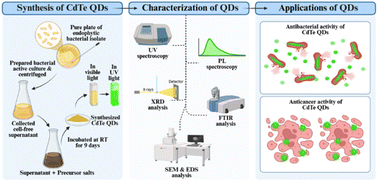
Antimicrobial resistance (AMR) and cancer are major health concerns that require efficient treatment strategies. An environmentally friendly extracellular biosynthesis of cadmium telluride quantum dots (CdTe QDs) was achieved using Paenibacillus dendritiformis, an endophytic bacterial strain. The biosynthesized CdTe QDs exhibited optical, physicochemical, and structural characteristics that were evaluated using UV-vis and photoluminescence spectroscopies, revealing a strong green fluorescence. Its monoclinic structure was revealed by XRD, and biomolecular capping was detected using FTIR spectroscopy. The zeta (ζ)-potential was evaluated to check their colloidal stability and negative surface charge of the particles, while FE-SEM revealed their surface morphology. Reactive oxygen species (ROS) production can be triggered by CdTe QDs, affecting essential biomolecules and bacterial membranes. The CdTe QDs also show the largest zone of inhibition of 20 mm against amoxicillin-resistant bacterial strains, Klebsiella pneumoniae (AMX 87) and Enterobacter hormaechei (AMX 03). They additionally exhibit anticancer activity against the human cervical cancer (HeLa) cell line with an IC50 of 60 µg mL−1 and the human lung cancer (A549) cell line with an IC50 of 65 µg mL−1. These results demonstrate the potential of biosynthesized CdTe QDs as an effective nanomaterial for treating AMR and cancer.
 Please wait while we load your content...


