


 PLATFORM UPDATE:


Eggshell-derived hydroxyapatite-alkali-activated waste glass composite for fluoride sequestration: characteristics and mechanistic insights and process optimization

Abstract
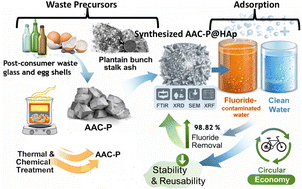
This study reports the development of a sustainable alkali-activated glass-hydroxyapatite composite (AAC-P@HAp) synthesized entirely from waste-derived precursors, including post-consumer glass bottles, eggshells, and plantain bunch stalk ash (as an alkali source), for fluoride removal from aqueous systems. The composite was produced through controlled alkali activation of micronized waste glass followed by hydrothermal-assisted integration of eggshell-derived hydroxyapatite within the aluminosilicate matrix. FTIR, XRF, SEM-EDX, and XRD confirmed successful composite formation of a hybrid silicate-phosphate material and revealed fluoride-induced changes in Ca–P domains after adsorption, indicating strong adsorbent–adsorbate interactions and chemical immobilization. Batch adsorption experiments demonstrated rapid fluoride uptake, with kinetic behavior adequately described by the pseudo-first-order model, while equilibrium data were better represented by the Freundlich isotherm, consistent with heterogeneous surface binding dominated by chemisorption. Thermodynamic analysis indicated that fluoride adsorption was spontaneous and endothermic. Within the Box–Behnken experimental domain, AAC-P@HAp achieved stable fluoride removal efficiencies in a narrow range (83–87%), with pH exerting the dominant influence on performance. Regeneration tests showed good initial reusability followed by a progressive decline attributed to irreversible chemisorption and depletion/phase transformation. In all, the results demonstrate the feasibility of converting multiple waste streams into a robust composite adsorbent and highlights AAC-P@HAp as a circular-economy-oriented material for secure fluoride immobilization rather than extensive multi-cycle reuse.
 Please wait while we load your content...


