


 PLATFORM UPDATE:

Sustainable and innovative electrochemical approach for quantifying glycine betaine in bacterial cultures

Abstract
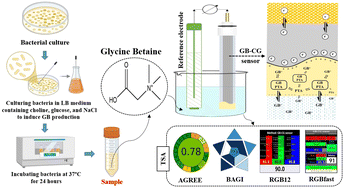
Monitoring bacterial biosynthesis in real-world developments using electrochemical sensing has been a challenging task. Our research focused on fabricating and optimizing a sustainable and economical electrochemical sensor (GB-CG) to quantify glycine betaine (GB) amount in various bacterial cultures. The sensor's design was based on the ion-association complex between GB and phosphotungstic acid (PTA) anion as an ion exchange site, using polyvinyl chloride (PVC) as the main polymeric matrix and dioctyl phthalate (DOP) as a solvent mediator/plasticizer. It exhibited a rapid, linear, and stable linear Nernstian response (57.52 mV per decade) over a wide concentration range (1 × 10⁻⁷ to 1 × 10⁻¹ M), with a detection limit of 1 × 10⁻⁸ M. The performance of the proposed sensor was evaluated in terms of selectivity, response time, operational lifespan, and pH/temperature working range, together with the key validation parameters. In comparison to a reported HPLC method, the sensor was efficiently utilized to determine the GB amount in three different bacterial cultures. The selected bacterial species were Escherichia coli, Bacillus subtilis, and Corynebacterium glutamicum. The sensor was also evaluated by using a Trichromatic Sustainability Assessment (TSA) protocol to ensure its environmental compatibility, sustainability, and practicality. Also, the proposed sensor was statistically compared to recently reported GB sensors, proving its reliability and optimal performance.
 Please wait while we load your content...


