


 PLATFORM UPDATE:


Nanoparticle formation utilizing simple polyacrylic acid-cation coacervates as template

Abstract
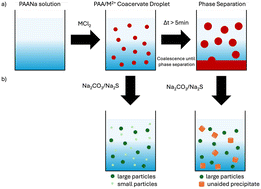
The liquid–liquid phase separation (coacervation) of simple solutions containing only polyacrylic acid (PAA) and multivalent transition metal (TM) cations can be used as a template for nanoparticle formation. It is shown that transition metal carbonate/sulfide/oxide nanoparticles can be prepared by a simple coacervate-mediated process using only PAA, the transition metal chloride, and either sodium carbonate or sulfide. The rather simple approach first demonstrated for calcium carbonate could be extended to the chosen transition metals Co, Mn, Ni, and Cu. Using DLS and UV/vis, the formation and properties of PAA/TM coacervates were studied showing that in a broad pH range, coacervation is possible when a critical cation concentration is reached. Using these findings, mineralization of the coacervates results in defined small nanoparticles that can be easily separated from other bigger residues. Calcination of carbonate particles results in their respective oxide counterparts. The rather small sizes (5 nm) of the primary particles and their amorphous crystal structure suggest further investigation into their use as catalysts.
 Please wait while we load your content...


