


 PLATFORM UPDATE:


UPLC-MS/MS analysis and bioactivity comparison of wild and cultivated Taihangia rupestris leaves: antioxidant and α-glucosidase inhibitory activities with active compound screening
 *b
and
*b
and
Abstract
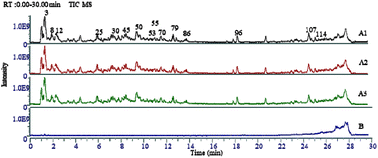
Taihangia rupestris Yu & Li (T. rupestris) was a nationally protected plant and its active compounds exhibit antidiabetic potential, but systematic phytochemical and pharmacological investigations remain limited. To balance conservation and utilization, the chemical composition and bioactivities (antioxidant and α-glucosidase inhibitory effects) of wild and cultivated T. rupestris were compared, followed by active compound screening. UPLC-MS/MS was used to identify chemical constituents in wild, mountain-cultivated, and foothill-cultivated samples, with multivariate analysis for differential components. The TFC and TPC, and the antioxidant capacity were evaluated via FRAP, CUPRAC, TRC, and DPPH assays. Additionally, α-glucosidase inhibition was assessed via IC50 determination. Online HPLC-ABTS and ultrafiltration-LC/MS (UF-LC/MS) were employed to screen antioxidants and α-glucosidase inhibitors (α-GIs), respectively, with molecular docking validating binding mechanisms. As a result, among 114 identified compounds, 111 showed significant environment-dependent variations, primarily flavonoids, phenolics, and terpenoids. Foothill-cultivated plants exhibited upregulated flavonoids/phenolics (e.g., rutin and gallic acid derivatives, P < 0.05) and superior antioxidant activity (Trolox equivalents: FRAP 367.18 ± 1.03; CUPRAC 572.40 ± 0.82) and α-glucosidase inhibition (IC50 0.2775 µg mL−1) versus wild (IC50 0.4948 µg mL−1) and mountain-cultivated samples (IC50 0.5425 µg mL−1). Ten antioxidants were screened, with seven also acting as α-GIs. UF-LC/MS and docking confirmed 8 α-GIs (binding energy < −5 kcal mol−1), where phenolic hydroxyl groups formed hydrogen bonds with ASP residues of α-glucosidase. Cultivated T. rupestris (especially foothill-grown) outperformed wild plants in bioactives composition and efficacy, serving as a sustainable alternative. Flavonoids and phenolics contributed to its antidiabetic potential via dual antioxidant and enzyme-inhibitory effects, supporting further pharmaceutical development.
 Please wait while we load your content...


