


 PLATFORM UPDATE:


Development, anti-proliferative activity, multi-target kinase inhibition against CHK1, PIM1, and CDK-2, and computational insights of new thiazole-based hybrids

Abstract
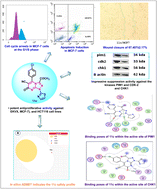
In the current medical landscape, multi-targeting by a single small molecule is recognized as an effective strategy in the fight against cancer. This study contributes to the global effort to combat cancer by focusing on the synthesis of novel thiazolopyrazoles 2–7, thiazolodiazenylyhiazoles 9a–c, and thiazolotriazolopyrimidines 11a–c. The diazonium salt of 2-aminothiazole was reacted with 3-chloroacetyl acetone, resulting in the formation of 2-oxo-N′-(thiazol-2-yl)propanehydrazonoyl chloride (1). This compound served as a key intermediate precursor for synthesizing the latter compounds, which were proposed as anti-proliferative candidates with multi-kinase inhibitory activities against CHK1, PIM1, and CDK-2. Most of the derivatives exhibited significant cytotoxic activities when assessed for their antiproliferative effects against various tumor cell lines, including lung (EKVX), breast (MCF-7), and colon (HCT116). Derivative 11c, featuring a triazolo[4,3-a]pyrimidine scaffold, exhibited significant antiproliferative activity against the evaluated cell lines (IC50 = 4.8, 5.6, and 6.50 µM, respectively). Furthermore, 11c demonstrated a favorable safety profile against FHC and MCF10A normal cells and showed notable inhibitory activity against the kinases PIM1, CDK-2, CK2α, and CHK1 (IC50 = 0.49 ± 0.02, 0.845 ± 0.05, 4.87 ± 0.18, and 0.032 ± 0.002 µM, respectively). Biological assays investigated the ability of compound 11c to induce apoptosis in MCF-7 cells, arrest the cell cycle at the G1/S phase, and suppress the growth activity of MCF-7 (the wound closure % = 67.407 ± 2.17%, compared to 94.815 ± 3.05% for untreated cells). Docking simulations suggested potential binding modes for 11c, which aligned closely with findings from enzymatic examinations. The in silico physicochemical properties, drug-likeness metrics, and ligand efficiency of 11c appeared to be promising.
 Please wait while we load your content...


