


 PLATFORM UPDATE:


Carbon dots derived from Averrhoa bilimbi fruit for the detection of cholesterol and chromium(vi)
 *ab
*ab
Abstract
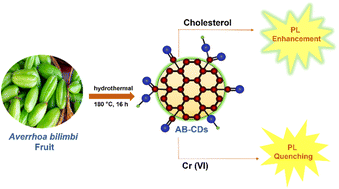
Carbon dots (CDs) are a class of carbon-based nanomaterials, typically less than 10 nm in size, known for their unique optical and electronic properties. Their discovery led to the opening of new avenues in nanotechnology, particularly in the field of fluorescence-based sensing. Owing to their strong photoluminescence, excellent aqueous solubility, low cytotoxicity, and potential surface functionalization, CDs have been considered as effective fluorescent probes for the detection of a wide range of analytes. Herein, we report the hydrothermal synthesis of CDs from a natural source, Averrhoa bilimbi fruit, leading to the formation of CDs exhibiting useful photoluminescent properties and potential for selective detection of cholesterol and Cr(VI) ions. The average particle size of Averrhoa bilimbi fruit-derived CDs (AB-CDs) was found to be 6.022 nm. The properties of AB-CDs were unravelled from structural and optical characterization and the applicability of AB-CDs as sensors for heavy metals and biomarkers was studied. The selective fluorescence response towards cholesterol and Cr(VI) makes it an efficient fluoroprobe for practical applications. The limits of detection for the sensing of cholesterol and Cr(VI) were estimated to be 0.31 µM and 1.71 µM respectively. The sensor system using AB-CDs is economical, sustainable, and eco-friendly.
 Please wait while we load your content...


