Issue 14, 2026, Issue in Progress

Photoelectrochemical performances of MoO2/TiO2 nanotube array (TNA) heterojunctions synthesized by SILAR method

Abstract

MoO2/TiO2 nanotube arrays (TNAs) were synthesized by the SILAR (successive ionic layer adsorption and reaction) method via the addition of ascorbic acid as a reductor. TNAs were synthesized using a two-step anodization method on Ti foil. Characterization was performed using UV-Vis DRS, XRD, Raman spectroscopy, and FESEM-EDX. Characterization results showed that MoO2 modification reduced the band gap from 3.21 eV to 1.56 eV, expanding light absorption into the visible region. Photoelectrochemical tests using a potentiostat with LSV and MPA methods showed that the MoO2/TNAs electrode had a higher current density than pure TNAs, indicating increased charge separation efficiency and photoelectrocatalytic activity.
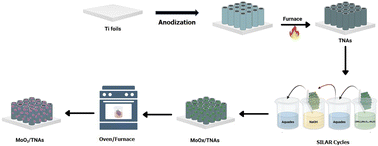
Graphical abstract: Photoelectrochemical performances of MoO2/TiO2 nanotube array (TNA) heterojunctions synthesized by SILAR method

Article information

Article type
Paper
Submitted
08 Jan 2026
Accepted
21 Feb 2026
First published
05 Mar 2026
This article is Open Access
Creative Commons BY-NC license

RSC Adv., 2026,16, 12537-12546

Photoelectrochemical performances of MoO2/TiO2 nanotube array (TNA) heterojunctions synthesized by SILAR method

D. N. Meisinca and S. Kasuma Warda Ningsih, RSC Adv., 2026, 16, 12537 DOI: 10.1039/D6RA00181E

This article is licensed under a Creative Commons Attribution-NonCommercial 3.0 Unported Licence. You can use material from this article in other publications, without requesting further permission from the RSC, provided that the correct acknowledgement is given and it is not used for commercial purposes.

To request permission to reproduce material from this article in a commercial publication, please go to the Copyright Clearance Center request page.

If you are an author contributing to an RSC publication, you do not need to request permission provided correct acknowledgement is given.

If you are the author of this article, you do not need to request permission to reproduce figures and diagrams provided correct acknowledgement is given. If you want to reproduce the whole article in a third-party commercial publication (excluding your thesis/dissertation for which permission is not required) please go to the Copyright Clearance Center request page.

Read more about how to correctly acknowledge RSC content.

Social activity

Spotlight

Advertisements