Issue 14, 2026, Issue in Progress

Enhanced electrochemical performance with Co-V-O bridges and dual active sites for water electrolysis applications

Abstract

Vanadium pentoxide (V2O5) exhibits broad application prospects in the field of battery cathode materials due to its layered structure and high theoretical specific capacity. However, its inherent low electrical conductivity and structural instability during cycling severely restrict its electrochemical performance. To overcome these bottlenecks, cobalt (Co)-doped V2O5 materials were successfully prepared via a hydrothermal synthesis method in this study. Characterization confirmed that Co ions were successfully incorporated into the V2O5 lattice, which effectively expanded the interlayer spacing and improved the electronic conductivity of the material. Electrochemical test results showed that compared with pure V2O5, the Co-V2O5 sample demonstrated excellent hydrogen evolution reaction and oxygen evolution reaction performances, with lower overpotentials and Tafel slopes. As a catalyst for driving water electrolysis, the sample exhibited a cell voltage of 1.38 V at 10 mA cm−2 and excellent long-cycle stability.
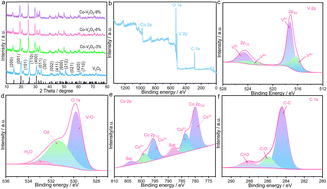
Graphical abstract: Enhanced electrochemical performance with Co-V-O bridges and dual active sites for water electrolysis applications

Supplementary files

Article information

Article type
Paper
Submitted
07 Jan 2026
Accepted
26 Feb 2026
First published
04 Mar 2026
This article is Open Access
Creative Commons BY-NC license

RSC Adv., 2026,16, 12256-12264

Enhanced electrochemical performance with Co-V-O bridges and dual active sites for water electrolysis applications

K. Zhao, Y. Yu, Y. Jia, Y. Ke, J. Wang, S. Song, Y. Li, F. Hu, D. Zhao and L. Miao, RSC Adv., 2026, 16, 12256 DOI: 10.1039/D6RA00151C

This article is licensed under a Creative Commons Attribution-NonCommercial 3.0 Unported Licence. You can use material from this article in other publications, without requesting further permission from the RSC, provided that the correct acknowledgement is given and it is not used for commercial purposes.

To request permission to reproduce material from this article in a commercial publication, please go to the Copyright Clearance Center request page.

If you are an author contributing to an RSC publication, you do not need to request permission provided correct acknowledgement is given.

If you are the author of this article, you do not need to request permission to reproduce figures and diagrams provided correct acknowledgement is given. If you want to reproduce the whole article in a third-party commercial publication (excluding your thesis/dissertation for which permission is not required) please go to the Copyright Clearance Center request page.

Read more about how to correctly acknowledge RSC content.

Social activity

Spotlight

Advertisements