


 PLATFORM UPDATE:


Mg/Mn co-doped CdS nanoparticles: a multifunctional platform for wastewater purification and antibacterial applications
 †*c
Nabil
Al-Zaqri
*g
†*c
Nabil
Al-Zaqri
*g
Abstract
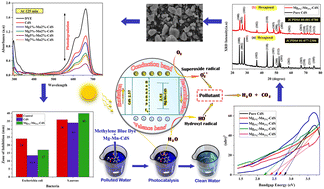
Developing nanomaterials with multifunctional properties that can address both biomedical and environmental challenges is the focus area of this research study. This work presents Mg and Mn co-doped CdS synthesized in a controlled way by a co-precipitation method utilizing ammonia hydroxide as both a capping and stabilizing agent. While fixing the Mn concentration at 2%, the Mg concentration was varied from 1% to 7% based on prior studies of the optical and electronic properties of CdS at these doping concentrations. X-ray diffraction analysis confirmed lattice expansion and a hexagonal phase along with crystal size reduction from 49.08 nm (pure CdS) to 42.94 nm for Mg5%–Mn2%-CdS, which is evidence of successful substitution. The reduction in the optical bandgap from 2.80 eV (pure CdS) to 2.19 eV (optimally co-doped sample) is evidence of the absorption enhancement of visible light. Methylene blue exhibited 84.79% degradation under visible-light irradiation within 125 min, following psuedo-first-order kinetics with a rate constant of 0.014 min−1 (R2 = 0.98). The dominant reducing species, ˙O2− and ˙OH, were confirmed by scavenger experiments. The same sample exhibited strong antibacterial activity by producing inhibition zones of 17 ± 0.2 mm against E. coli and 40 ± 0.3 mm against S. aureus, which surpassed the activity of pure CdS, approaching the standard antibiotic efficiency. These results suggest that Mg–Mn-co-doped samples are stable, dual-functional, and suitable for both wastewater purification and antimicrobial applications.
 Please wait while we load your content...


