


 PLATFORM UPDATE:


Mechanochemical solid-state synthesis of Pd-based catalysts with tunable size effects for Suzuki–Miyaura coupling reaction
 *a
and
Ndzondelelo
Bingwa
*b
*a
and
Ndzondelelo
Bingwa
*b
Abstract
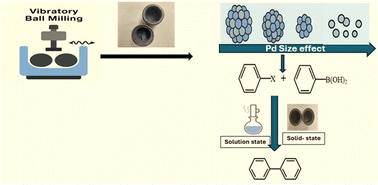
Palladium catalysts are widely used in the Suzuki–Miyaura cross-coupling reaction; however, their high cost and scarcity demand strategies to reduce Pd usage without compromising catalytic performance. In this study, we report supported Pd catalysts with low loading, prepared by the ball milling method, an eco-friendly and efficient route to highly active catalysts. These low-loading Pd catalysts were supported on alumina (Al2O3), silica (SiO2), and titania (TiO2). The influence of support properties on catalytic performance in the Suzuki–Miyaura coupling reaction was systematically investigated. In this work all Pd catalysts exhibit good thermal stability with less than 10% weight loss at 1000 °C. They have high surface areas ranging between 20.6 ± 1.0 to 296 ± 15 m2 g−1. Diffuse Reflectance Ultraviolet-Visible (DR-UV-Vis) spectroscopy indicated that smaller clusters have altered redox potentials; their electron density changes due to introduction of discrete, redox-active states that strongly couple with the oxide support. A comparison was made between the solution-phase and solid-phase methods for the Suzuki–Miyaura reaction. The catalysts exhibited excellent catalytic activity, achieving up to 97% substrate conversion within one hour at room temperature via the mechanochemical route. These catalysts also showed good reusability for at least four catalytic cycles without losing significant activity. Therefore, our study offers an eco-friendly method to develop highly stable Pd-based catalysts for efficient catalytic Suzuki–Miyaura reaction.
 Please wait while we load your content...


