


 PLATFORM UPDATE:


Photocatalytic degradation of ibuprofen on titanium oxide nanoparticles: insights into degradation kinetics, mechanisms, thermodynamics, pathways, and toxicity

Abstract
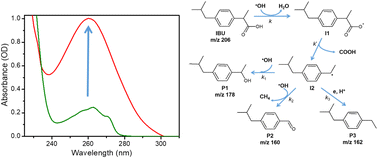
The photocatalytic degradation of ibuprofen (IBU) in aqueous solution using titanium dioxide nanoparticles (TiO2 NPs) as a photocatalyst activated by 365 nm UV light irradiation was systematically investigated. The degradation of IBU was monitored by absorption spectroscopy, and the resulting overlapping spectra were deconvoluted to determine the concentrations of residual IBU and its photocatalytic degradation products. Effective immobilization and strong affinity of IBU for the photocatalyst surfaces were evidenced by the maximum adsorption capacity of 126 ± 4 mg g−1 on TiO2 NPs. Liquid chromatography-mass spectrometry and Fourier-transform infrared spectroscopy revealed that the stable photocatalytic degradation products were 1-(4-isobutylphenyl)ethanol, 4-isobutylbenzaldehyde, and 4-isobutyl-1-ethylbenzene, rather than complete mineralization to carbon dioxide and water. The degradation pathways were proposed to involve hydroxyl radical (OH˙) attack on the carboxylic group of IBU, leading to the formation of short-lived intermediates, followed by decarboxylation, hydroxylation, and demethylation reactions. The photocatalytic degradation was endothermic and spontaneous, accompanied by an increase in disorder. Based on the simplified Langmuir–Hinshelwood model, the observed degradation rate constant was 1.31 ± 0.02 × 10⁻² min−1, primarily governed by mass transfer from the bulk solution to the photocatalyst surfaces. Toxicity assessments indicated that the photocatalytic degradation products of IBU are less toxic toward Artemia salina larvae, suggesting a reduced toxicity risk to microorganisms in the environment.
 Please wait while we load your content...


