


 PLATFORM UPDATE:


A bidirectionally conductive composite membrane based on copper-coated electrospun PI-CNT fibers as a current collector for lithium-ion batteries
 a
and
Hai
Fu
*a
a
and
Hai
Fu
*a
Abstract
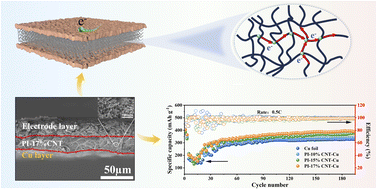
This study aims to reduce dependence on copper while enhancing the energy density of lithium-ion batteries. Plastic-based current collectors (PBCCs) offer a promising approach to replace copper, minimize the proportion of inactive material, and ultimately increase the energy density of lithium-ion batteries. A key challenge involved the synergistic optimization of the PBCC's conductive framework and its interfacial surface properties. Herein, a PI-CNT-Cu composite membrane was constructed by depositing copper onto electrospun PI fibers containing CNTs. This hierarchical architecture coupled the intrinsic longitudinal conductivity of the CNT network within the fibers with the transverse conductivity of the continuous copper layer, resulting in a composite membrane with a volumetric conductivity of 5.6 × 10³ S cm−1. In the electrochemical performance evaluations, graphite anodes employing PI-CNT-Cu CCs exhibited a capacity retention of 95.29% after 190 cycles at 0.5C. The performance enhancement could be attributed to the markedly rougher surface of the PI-CNT-Cu CC (Sa = 2.668 µm) relative to copper foil (Sa = 0.938 µm). This morphology enhanced the contact area and adhesion with the electrode layer, which was crucial for maintaining the structural integrity of the electrode during long-term cycling. In contrast to copper foil, the PI-CNT-Cu CC, with its fiber-woven structure, exhibited a significantly lower areal density with identical thickness values. The capacity of the anode electrode, was calculated based on the total mass including active materials and CCs. Utilizing PI-17%CNT-Cu exhibited significantly higher discharge capacities of 81.7 mA h g−1 at the same rates compared to the Cu foil at 35.08 mA h g−1.
 Please wait while we load your content...


