


 PLATFORM UPDATE:


Research on terahertz multitunable multifunctional absorbers based on graphene and indium antimonide
 *a
*a
Abstract
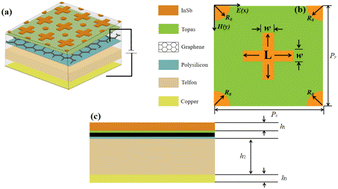
This article proposes a dual-band terahertz multi-functional absorber based on graphene and indium antimonide (InSb), which can be electrically, thermally, and magnetically tuned. The results indicate that, in the absence of an external magnetic field, the absorber exhibits two distinct absorption peaks based on the bright–bright mode coupling of cross-shaped and circular InSb arrays, with an average absorption rate of 99.8%. Meanwhile, its physical absorption mechanism can be theoretically analyzed by the radiating two-oscillator (RTO) model and the distribution of electric field at absorption peaks. Secondly, when the external magnetic field is applied along the X direction, the absorption frequency and absorption rate of the absorber can be electrically tuned by changing the chemical potential of graphene, and thermally and magnetically controlled by changing the temperature of InSb and the magnitude of the external magnetic field. Afterwards, the effects of the length and width of the cross-shaped InSb array, the radius of the InSb circle, and the thickness of the dielectric layer on the absorption effect are discussed. Finally, further studies are conducted on the application prospects of the absorber as a refractive index sensor, temperature sensor, and magnetic field sensor. This work provides a theoretical basis for the design of multi-tuned absorbers and sensors.
 Please wait while we load your content...


