


 PLATFORM UPDATE:


First-principles calculations to investigate structural, electronic, optical, elastic, mechanical and phonon properties of novel Q3GaBr6 (Q = Na and K) for next-generation lead-free solar cells

Abstract
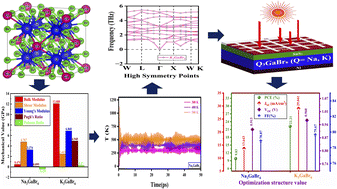
Lead-free halide perovskites have emerged as promising alternatives to toxic Pb-based photovoltaic absorbers, yet many candidates suffer from poor stability or unfavorable electronic properties. In this work, we present the first comprehensive first-principles and device-level investigation of the novel vacancy-ordered perovskites Q3GaBr6 (Q = Na, K) to evaluate their potential for next-generation optoelectronic and solar-cell applications. Density functional theory (DFT) calculations confirm that both compounds crystallize in a stable cubic Fm![[3 with combining macron]](https://www.rsc.org/images/entities/char_0033_0304.gif) m phase with negative formation energies, favorable tolerance factors, and strong Ga–Br bonding within rigid octahedral frameworks. Electronic-structure analysis reveals direct band gaps of 1.445 eV (K3GaBr6) and 1.991 eV (Na3GaBr6), with Br-4p states dominating the valence band and Ga-/Q-site orbitals contributing to the conduction band. Optical studies show high absorption (>104 cm−1 in the visible region), low reflectivity, strong dielectric response, and pronounced UV absorption, indicating suitability for broadband optoelectronics. Mechanical and phonon analyses further confirm mechanical stability, moderate stiffness, and absence of imaginary phonon modes, while AIMD simulations validate excellent thermal robustness at elevated temperatures. Incorporating DFT-extracted parameters into SCAPS-1D device modeling demonstrates promising photovoltaic performance, with efficiency, current density, and fill factor strongly influenced by absorber thickness, defect density, and doping concentration. Under ideal simulated conditions, the device shows a theoretical upper-limit efficiency of 22.21%. The proposed DFT–SCAPS integrated approach provides an efficient and computationally economical route to screen and optimize lead-free perovskite absorbers, significantly reducing experimental trial-and-error while enabling accurate prediction of photovoltaic performance.
m phase with negative formation energies, favorable tolerance factors, and strong Ga–Br bonding within rigid octahedral frameworks. Electronic-structure analysis reveals direct band gaps of 1.445 eV (K3GaBr6) and 1.991 eV (Na3GaBr6), with Br-4p states dominating the valence band and Ga-/Q-site orbitals contributing to the conduction band. Optical studies show high absorption (>104 cm−1 in the visible region), low reflectivity, strong dielectric response, and pronounced UV absorption, indicating suitability for broadband optoelectronics. Mechanical and phonon analyses further confirm mechanical stability, moderate stiffness, and absence of imaginary phonon modes, while AIMD simulations validate excellent thermal robustness at elevated temperatures. Incorporating DFT-extracted parameters into SCAPS-1D device modeling demonstrates promising photovoltaic performance, with efficiency, current density, and fill factor strongly influenced by absorber thickness, defect density, and doping concentration. Under ideal simulated conditions, the device shows a theoretical upper-limit efficiency of 22.21%. The proposed DFT–SCAPS integrated approach provides an efficient and computationally economical route to screen and optimize lead-free perovskite absorbers, significantly reducing experimental trial-and-error while enabling accurate prediction of photovoltaic performance.
 Please wait while we load your content...


