


 PLATFORM UPDATE:


Optoelectronic and photovoltaic assessment of Na2ReAlO6 double perovskite: insights from DFT and SCAPS modeling

Abstract
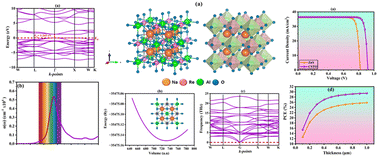
The recent progress in oxide double perovskite (DP) based perovskite solar cells (PSCs) has driven extensive research aimed at enhancing device performance owing to their remarkable optoelectronic properties. The oxide double perovskite Na2ReAlO6 has emerged as a promising Pb-free alternative to conventional lead-based absorbers due to its reduced toxicity, enhanced chemical stability, and favorable optoelectronic characteristics. In order to explore the structural, electronic, and optical behavior of Na2ReAlO6, density functional theory calculations were carried out using the full-potential linearized augmented plane wave (FP-LAPW) method in conjunction with the Tran-Blaha modified Becke–Johnson potential (TB-mBJ) and PBE-GGA within the Wien2K framework. A favorable tolerance factor and a phonon dispersion profile devoid of imaginary frequencies validate structural and dynamical stability. The material is suitable for photovoltaic (PV) and energy-related applications due to its direct bandgap of 1.24 eV with noble electrical stability and pronounced visible-light absorption (104 cm−1) and high dielectric constant, indicating suitability for efficient solar energy conversion. Further SCAPS-1D (Solar Cell Capacitance Simulator in one dimension) was used to simulate the PV performance of Na2ReAlO6-based solar cell designs. The optimized structure of Na2ReAlO6 was integrated into heterostructured PSCs using CSTO and ZnS as electron transport layers (ETLs) and Cu2O as the hole transport layer (HTL) are optimized to demonstrate the photovoltaic features of simulated PSCs delivering a power conversion efficiency (PCE) up to 29%. These findings demonstrate the device-level potential of Na2ReAlO6 for Pb-free PSCs as a stable, non-toxic and extremely effective oxide DP absorber.
 Please wait while we load your content...


