


 PLATFORM UPDATE:

Construction of a Cu/Fe/S multi-active-site synergistic Fenton-like system via mechanically activated natural copper sulfide ore for efficient tetracycline degradation

Abstract
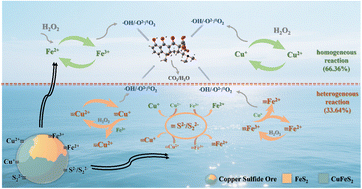
Addressing the underexplored catalytic potential of natural polymetallic sulfide minerals and the unclear structure–activity relationship between symbiotic structures and catalytic performance, this study explores the use of mechanically activated natural copper sulfide ore to construct a bimetallic synergistic Fenton-like system for tetracycline degradation, with a focus on the synergistic role of Cu/Fe/S multi-active sites. By optimizing ball milling parameters (ball-to-powder ratio of 3 : 1, duration of 24 h), the catalyst achieved a remarkable 90.11% tetracycline degradation within 10 minutes. Mechanistic investigations revealed that mechanical activation refined particle size, increased specific surface area, and exposed more Cu/Fe/S active sites, establishing a “homogeneous (66.36%) – heterogeneous (33.64%)” synergistic catalytic mechanism. In the homogeneous phase, dissolved Cu2+/Fe2+ accelerated H2O2 decomposition. In the heterogeneous phase, the Cu+/Fe3+ redox couple (0.16 V/0.77 V) created an energy level difference. Coupled with reductive sulfur species (S2−, S22−)-mediated electron transfer, this facilitated the Fe3+ → Fe2+ and Cu2+ → Cu+ cycles, thereby enhancing radical generation efficiency. Two distinct degradation pathways for tetracycline by the copper sulfide concentrate were identified, with intermediates undergoing deep oxidation and ring-opening reactions to mineralize into H2O, CO2, and NO3−. This study overcomes the limitations of traditional single iron-based sulfide catalysts, revealing the catalytic enhancement mechanism of natural mineral symbiotic structures under mechanical activation. It offers a cost-effective and efficient heterogeneous Fenton-like solution for antibiotic wastewater treatment.
 Please wait while we load your content...


