


 PLATFORM UPDATE:


Enhancing microbial electrosynthesis of fatty acids from carbon dioxide by combining bioaugmentation of an acetogenic enrichment and Fe–Sn oxide cathode coating

Abstract
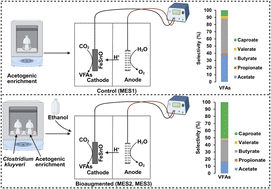
This study evaluated the impact of bioaugmenting a mixed acetogenic enrichment with Clostridium kluyveri on CO2 reduction to fatty acids, specifically butyrate and caproate, in a microbial electrosynthesis (MES) cell equipped with an Fe-Sn oxide – coated cathode. Without bioaugmentation, at a volumetric CO2 inflow of 1.67 LCO2 (Lc d)−1 (per cathode chamber volume) approximately 86% of the CO2 was converted to the target products, leading to maximum production rates of butyrate and caproate of 875 mg (Lc d)−1 and 94 mg (Lc d)−1, respectively. With inoculum bioaugmentation and ethanol supplementation, CO2 conversion reached 85% at a higher inflow rate of 2.78 LCO2 (Lc d)−1 and the production of butyrate and caproate reached 733 mg (Lc d)−1 and 792 mg (Lc d)−1, respectively. Biomolecular analysis of microbial populations confirmed the proliferation of the bioaugmented C. kluyveri in cathodic biofilms and liquid, however only under an external ethanol supply. In addition, the MES cells also featured a significant quantity of the chain-elongating bacterium Megasphaera sueciensis. Initial microbial conversion of H2 and CO2 in the cells was most likely carried out by a so-far undescribed representative of the Bacillota BRH-c20a clade. Overall, this study demonstrates that by combining advanced cathode materials, such as Fe-Sn bimetallic oxide, with a specialized bioaugmented microbial consortium, a high rate of butyrate and caproate production from CO2 can be achieved.
 Please wait while we load your content...


