


 PLATFORM UPDATE:


MOF-derived ternary ZnCo–Ni LDHs for high-energy-density supercapacitors: synergistic effects and enhanced ion transfer
 †ab
Yiwen
Tang
*b
and
†ab
Yiwen
Tang
*b
and
Abstract
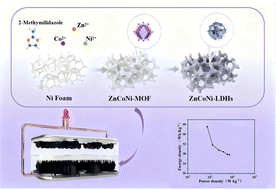
The development of electrode materials that simultaneously possess high energy density and excellent cycling stability remains a critical challenge hindering the widespread application of supercapacitors. Consequently, traditional binary layered double hydroxides (LDHs) suffer from nanosheet stacking and limited active sites. To address this issue, this paper proposes an innovative strategy to construct ternary LDHs using metal–organic frameworks (MOFs) as precursor templates. Three-dimensional nanoflower-like ZnCo–Ni LDHs (ZCN-LDHs) were fabricated on a ZnCo-MOF template via in situ nickel ion introduction and an optimized solvothermal process. This unique 3D hierarchical architecture effectively inhibits the stacking of nanosheets and provides abundant ion transport pathways. Benefiting from the proposed synergistic interplay among Zn, Co, and Ni ions within the unique 3D architecture, the ZCN-LDHs-1802h electrode delivers a high specific capacity of 2288 F g−1 at 1 A g−1. This enhanced performance is hypothesized to originate from the combined effects of improved electronic structure and increased redox activity, as suggested by electrochemical impedance spectroscopy (EIS) and cyclic voltammetry (CV) analyses. Furthermore, an asymmetric supercapacitor (ASC) assembled with ZCN-LDHs-1802h and commercial activated carbon (AC) achieves an energy density of 39.1 Wh kg−1 at a power density of 750 W kg−1.
 Please wait while we load your content...


