


 PLATFORM UPDATE:


Hydrolyzed collagen-modified bacterial cellulose loaded with tea tree oil for antibacterial activity against acne-associated bacteria
 *ac
*ac
Abstract
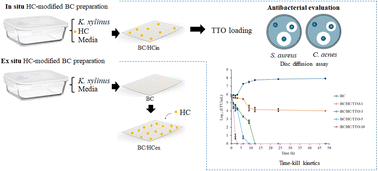
Acne is a chronic inflammatory skin disorder commonly treated with topical antibiotics, whose long-term use is limited by antimicrobial resistance and adverse effects. Tea tree oil (TTO) is a natural antimicrobial agent effective against acne-associated bacteria; however, its clinical application is hindered by volatility, oxidative instability, and skin irritation at high concentrations. In this study, a novel biopolymer-based delivery system was developed using bacterial cellulose modified with hydrolyzed collagen (BC/HC) to enhance the loading, stability, and antibacterial efficacy of TTO for potential acne therapy. BC/HC composites were prepared via both in situ and ex situ collagen modification approaches and comprehensively characterized for their physicochemical properties. In situ modification significantly reduced crystallinity (from ∼81% in native BC to ∼76% at the highest HC content), increased porosity, and improved water-holding capacity, resulting in markedly enhanced TTO loading efficiency-up to eightfold compared with unmodified BC when loaded in the swollen state. The TTO-loaded BC/HC composites exhibited a desirable biphasic release profile with an initial burst followed by sustained release. Concentration-dependent antibacterial activity against Staphylococcus aureus and Cutibacterium acnes was demonstrated through disc diffusion and time-kill kinetic assays, which showed no detectable colonies within 2–3 h at the highest TTO loadings. Stability studies showed that high terpinen-4-ol content (>90%) and approximately 70% antibacterial activity were retained after three months under both normal and accelerated storage conditions for composites with high TTO loading, significantly outperforming conventional substrates. Overall, in situ HC-modified BC represents a promising, natural, and sustainable delivery platform for TTO, offering enhanced loading capacity, controlled release, potent antibacterial activity, and improved stability, with strong potential as a topical antimicrobial platform active against acne-associated bacteria.
 Please wait while we load your content...


