


 PLATFORM UPDATE:


On the ozonation of anti-SARS-CoV-2 substances and their nucleoside analogues for mechanistic understanding of the ozone induced transformation using HPLC-ESI-Q-TOF-HRMS

Abstract
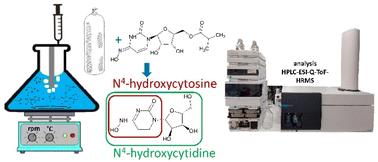
During the COVID-19 pandemic, known and newly developed pharmaceuticals were investigated and approved for treatment against the SARS-CoV-2 virus, among them the prodrug molnupiravir and its active metabolite EIDD-1931. Their reactivity towards ozone is of particular interest, since advanced oxidation processes are heavily researched for their application in wastewater treatment. As a strong oxidant, ozone degrades micropollutants, enhancing contaminant removal. While the ecotoxicological effects of molnupiravir and EIDD-1931 have recently been assessed, the drugs' exposition to ozone has not been studied. In pursuit of the mechanistic elucidation, N4-hydroxycytosine, which represents a structural subunit of molnupiravir and EIDD-1931, was studied. Further comparison with pyrimidine-2-one and the pyrimidine-based nucleobases cytosine and uracil corroborated the proposed structures of the detected transformation products. The fundamental insights obtained for N4-hydroxycytosine were then applied to the ozonation of molnupiravir and EIDD-1931. The investigation extended the understanding of the ozonation processes of pyrimidine-2-one derivatives and of this class of antiviral compounds through identification and elucidation of transformation products and through contribution to databases with newly reported MS/MS fragments. While 19 intermediate products and 17 more persistent products were observed, 23 transformation products were assigned identification confidence levels: 2 TPs at level 1, 7 at level 2, 17 at level 3, 4 at level 4, and 6 at level 5. The transformation mechanisms connecting the transformation products were proposed. The findings shall advance the mechanistic understanding of exposing antiviral drugs to ozonation and support the assessment of emerging pharmaceutical micropollutants.
 Please wait while we load your content...


