


 PLATFORM UPDATE:


Hydrothermal synthesis of nitrogen- and sulfur-co-doped carbon quantum dots from rice straw for fluorescent detection of Hg2+ in aqueous media
 a
Bao Long
Hoang,
a
Van Duong
Pham,
b
Hop Bao Tung
Nguyen,
a
Tuan Anh
Pham
a
and
Thi Thao
Vu
*a
a
Bao Long
Hoang,
a
Van Duong
Pham,
b
Hop Bao Tung
Nguyen,
a
Tuan Anh
Pham
a
and
Thi Thao
Vu
*a
Abstract
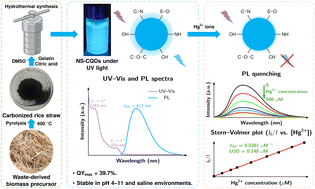
Biomass-derived carbon quantum dots (CQDs) have emerged as promising fluorescent nanomaterials owing to their low toxicity, cost-effectiveness, and facile synthesis, making them attractive for sensing applications. In this study, nitrogen- and sulfur-co-doped CQDs (NS-CQDs) were synthesized from rice straw via a simple and low-cost hydrothermal route using gelatin and dimethyl sulfoxide as nitrogen and sulfur sources, without the need for strong acids or advanced processing techniques. The as-prepared NS-CQDs exhibited intense blue emission with a high quantum yield of 39.7%, significantly exceeding that of undoped CQDs. A fluorescence-based sensing platform was constructed using the NS-CQDs, which showed high selectivity and sensitivity toward Hg2+ ions, with a wide linear detection range of 0–100 µM and a low detection limit of 0.148 µM, enabling practical mercury monitoring. Spectroscopic and electrokinetic analyses indicate that fluorescence quenching is governed predominantly by static complex formation between Hg2+ and surface O-, N-, and S-containing functional groups, with a minor contribution from dynamic quenching. Furthermore, application to real water samples demonstrated reliable recoveries and good reproducibility. This work provides a sustainable strategy for valorizing agricultural residues into high-performance fluorescent nanomaterials and offers a promising platform for environmental mercury monitoring.
 Please wait while we load your content...


