


 PLATFORM UPDATE:


A novel room-temperature CQD fluorescent nanosensor for the first derivatization-free spectrofluorimetric determination of dalfampridine: application to biological fluids and content uniformity testing

Abstract
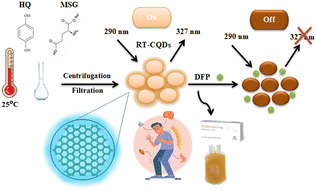
This study presents a novel approach for producing luminescent carbon quantum dots (CQDs) at room temperature (RT) utilizing hydroquinone and monosodium glutamate (MSG) as precursors through a simple reaction with no energy consumption. The produced RT-CQDs have a tiny diameter of 3.6 nm and a high quantum yield of 38.05%. Many spectroscopic and microscopic techniques, including HRTEM, zeta potential, EDX, FT-IR, UV/Visible, and fluorescence spectroscopy were utilized to characterize the produced RT-CQDs. After excitation at 290 nm, the RT-CQDs showed a high emission at 327 nm. The produced RT-CQDs' fluorescence signal was quantitatively decreased by dalfampridine (DFP), enabling their use as a sensitive fluorescent nanosensor to measure DFP in different matrices without the need for any pre-derivatization steps or a large volume of organic solvents, for the first time. The developed method showed a correlation coefficient of 0.9998, wide linearity range of 0.02–14.0 µg mL−1, and a detection limit of 0.005 µg mL−1, indicating the method's exceptional sensitivity. The proposed method was effectively used to determine DFP in tablets and human plasma samples, with low% RSD and high% recoveries. Moreover, the DFP tablets' content uniformity testing was carried out in compliance with USP criteria. Furthermore, the newly published greenness, blueness, and violetness assessment tools proved the low environmental effect, excellent practicality, good analytical performance, and novelty of the proposed DFP sensing approach. The developed method was fully validated according to ICH guidelines. The production of CQDs with superior qualities at room temperature under mild conditions opens the door for further developments in CQD room temperature synthesis and provides an effective substitute for conventional synthesis methods.
 Please wait while we load your content...


