Issue 10, 2026, Issue in Progress

Tetrad or triad? insights from a versatile Fe(ii) structural and functional model of the 3-histidine 1-carboxylate tetrad in C–C bond cleaving dioxygenase enzymes

Abstract

A new N3O coordinate ferrous complex modeling the 3-histidine-1-carboxylate tetrad – a dioxygenase active site – was synthesized and crystallographically characterized, ([Fe(II)(N-(ethyl-N′Me2)(Py)(2-t-ButPhOH))(OTf)]), 1. Complex 1 displays versatile C–C bond cleavage activity towards 2-hydroxyacetophenone, 3-hydroxyflavone, and 3,3-dihydroxypentan-2,4-dione in the presence of O2. This reactivity was studied through UV-vis and NMR spectroscopy alongside DFT calculations. The latter suggests that 1 forms an Fe(III)O2 adduct during the oxidation of 2-hydroxyacetophenone. Additionally, 1 displays direct activation of O2 in the absence of substrate, allowing it to access reactivity akin to more traditional N2O enzymatic coordination motifs. This versatility points to the need to reconsider mechanisms in N3O coordinate enzymatic systems and biomimetic models thereof. Moreover, this research makes the case that carefully designed N3O complexes merit further investigation as functional mimics of the canonical non-heme iron dioxygenase enzyme coordination environment.
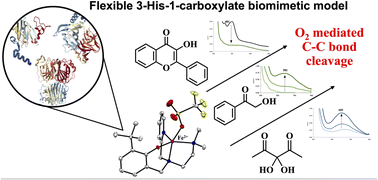
Graphical abstract: Tetrad or triad? insights from a versatile Fe(ii) structural and functional model of the 3-histidine 1-carboxylate tetrad in C–C bond cleaving dioxygenase enzymes

Supplementary files

Article information

Article type
Paper
Submitted
16 Dec 2025
Accepted
04 Feb 2026
First published
13 Feb 2026
This article is Open Access
Creative Commons BY-NC license

RSC Adv., 2026,16, 8695-8708

Tetrad or triad? insights from a versatile Fe(II) structural and functional model of the 3-histidine 1-carboxylate tetrad in C–C bond cleaving dioxygenase enzymes

A. Fadul, T. Cundari, J. Bertke and S. A. Toledo, RSC Adv., 2026, 16, 8695 DOI: 10.1039/D5RA09716A

This article is licensed under a Creative Commons Attribution-NonCommercial 3.0 Unported Licence. You can use material from this article in other publications, without requesting further permission from the RSC, provided that the correct acknowledgement is given and it is not used for commercial purposes.

To request permission to reproduce material from this article in a commercial publication, please go to the Copyright Clearance Center request page.

If you are an author contributing to an RSC publication, you do not need to request permission provided correct acknowledgement is given.

If you are the author of this article, you do not need to request permission to reproduce figures and diagrams provided correct acknowledgement is given. If you want to reproduce the whole article in a third-party commercial publication (excluding your thesis/dissertation for which permission is not required) please go to the Copyright Clearance Center request page.

Read more about how to correctly acknowledge RSC content.

Social activity

Spotlight

Advertisements