


 PLATFORM UPDATE:


Eco-sustainable chitosan–PVA biocomposites reinforced with recycled alum: preparation, characterization, and antimicrobial assessment

Abstract
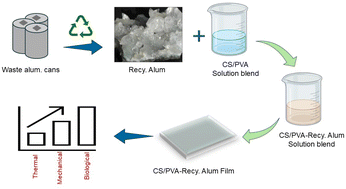
This study presents a sustainable approach to valorize aluminum can waste by converting it into recycled potassium alum (Recy. Al), used as a reinforcing and bioactive filler in chitosan/poly(vinyl alcohol) (CS/PVA) biocomposites. Recy. Al was synthesized through a green precipitation process and incorporated (5–50 wt%) into CS/PVA matrices via solution casting. FTIR and XRD confirmed successful alum integration without altering the matrix's semi-amorphous structure. Thermal analysis revealed enhanced stability, with 5% and 10% weight-loss temperatures (Td5, Td10) increasing from 188 °C and 239 °C for pristine CS/PVA to 223 °C and 240 °C for the 50 wt% composite, along with a higher char yield (38%). Mechanical strength and stiffness improved, reaching 21.1 ± 3.3 MPa and 501.3 ± 15.9 MPa at 30 wt% loading. SEM/EDS confirmed uniform alum dispersion and strong polymer-filler adhesion. Biologically, the CS/PVA–20 wt% composite showed potent antibacterial activity (MIC = 7.8 ± 1.0 µg mL−1; MCD ≈ 15 µg mL−1) against E. coli and S. aureus, while the CS/PVA–10 wt% sample exhibited the highest antifungal effect against S. cerevisiae and A. niger. Cytotoxicity tests confirmed good biocompatibility up to 20 wt% Recy. Al. These findings demonstrate that biocomposite films are thermally stable, antimicrobial, and eco-friendly materials for sustainable applications.
 Please wait while we load your content...


