Issue 13, 2026, Issue in Progress

Sm2+ doped strontium pentaborate chloride for dual-modal temperature imaging

Abstract

A multimodal thermometry material, Sm2+ doped Sr2B5O9Cl, was successfully synthesized and investigated for its potential in thermometry and temperature imaging. The temperature-dependent behaviors of the fluorescence intensity ratio (FIR), decay lifetime, dual-light-path intensity ratio (DLIR) and time-resolved intensity ratio (TRIR) were systematically studied, revealing high temperature sensitivity for each strategy. To facilitate temperature imaging, charge-coupled device (CCD) cameras were employed instead of conventional spectrometers to record the spatial distribution of fluorescence intensity and establish calibration curves correlating temperature. Temperature distribution imaging on printed circuit boards was successfully demonstrated using both the DLIR method and the TRIR technique. The results indicate that the developed material exhibits excellent performance for both thermometric sensing and temperature imaging applications.
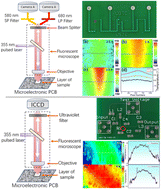
Graphical abstract: Sm2+ doped strontium pentaborate chloride for dual-modal temperature imaging

Supplementary files

Article information

Article type
Paper
Submitted
12 Dec 2025
Accepted
25 Feb 2026
First published
03 Mar 2026
This article is Open Access
Creative Commons BY-NC license

RSC Adv., 2026,16, 12092-12099

Sm2+ doped strontium pentaborate chloride for dual-modal temperature imaging

Z. Cao, Z. Liao, Q. Zhang, L. Li, X. Zhou, S. Jiang, G. Xie, Y. Chen, M. Yin and X. Wei, RSC Adv., 2026, 16, 12092 DOI: 10.1039/D5RA09629D

This article is licensed under a Creative Commons Attribution-NonCommercial 3.0 Unported Licence. You can use material from this article in other publications, without requesting further permission from the RSC, provided that the correct acknowledgement is given and it is not used for commercial purposes.

To request permission to reproduce material from this article in a commercial publication, please go to the Copyright Clearance Center request page.

If you are an author contributing to an RSC publication, you do not need to request permission provided correct acknowledgement is given.

If you are the author of this article, you do not need to request permission to reproduce figures and diagrams provided correct acknowledgement is given. If you want to reproduce the whole article in a third-party commercial publication (excluding your thesis/dissertation for which permission is not required) please go to the Copyright Clearance Center request page.

Read more about how to correctly acknowledge RSC content.

Social activity

Spotlight

Advertisements