


 PLATFORM UPDATE:


Optimization and scalability of two-electron water oxidation using C-fibre paper as electrode assisted by sodium stannate

Abstract
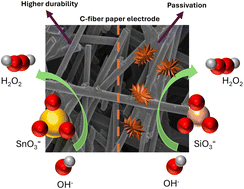
Electrochemical H2O2 generation offers a safer, cost-effective, and sustainable alternative for H2O2 production compared to classical methods. The two-electron water oxidation reaction (2e− WOR) has a significant advantage over the cathodic pathway, as it can be coupled with other reduction processes, such as CO2 valorization. Several anodic materials have been explored, with boron-doped diamond (BDD) standing out due to its high performance, but its high cost limits scalability. In this regard, recent studies have demonstrated the possibility of using cost-effective carbon materials by controlling the media conditions. In this work, we present a comparison between C-fibre paper (CFP) and BDD as anodes for 2e− WOR. By thoroughly adjusting the operating parameters, CFP achieves more stable production and maintains similar or even higher generation rates and faradaic efficiencies (FE). Moreover, electrode passivation issues related to the use of Na2SiO3 additive were identified, and Na2SnO3 was proposed as a novel alternative stabilizer for H2O2 electrogeneration with excellent results in terms of production and anode durability. Up to 23.3 µmol cm−2 min−1 production rates and ∼38% FE were achieved using a bare CFP electrode in both H and flow-cell configurations, and CFP electrode behaviour was stable after three 6-hour cycles in a flow cell, showing the scalability potential of the developed system.
 Please wait while we load your content...


