


 PLATFORM UPDATE:


Machine learning driven identification of optimal nanomaterials for efficient pararosaniline dye removal from water using a RFHGB hybrid model

Abstract
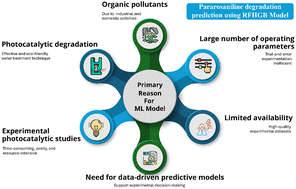
Water pollution by emerging contaminants requires advanced treatment technologies aside from conventional approaches due to the particular threat they pose to environmental and public health. Pararosaniline dye pollutant (PRS) is generally used in textile and biological staining applications, which may result in strong chemical stability, low biodegradability, and high toxicity, making its complete removal from wastewater so difficult. In this study, a ZnO–CuO nanocomposite and SrO photocatalysts were synthesized by experimental means and evaluated for photocatalytic degradation of PRS under controlled conditions. A dataset consisting of 81 experimental observations was computationally expanded to 5000 using synthetic data augmentation. Fifteen machine learning algorithms were trained to predict degradation efficiency, and the top five models were identified based on their performance metrics. Pairwise hybridization of the best five models produced ten hybrid combinations, out of which the Random Forest + HistGradient Boosting hybrid model (RFHGB-hybrid model) demonstrated the highest accuracy and lowest prediction error. The model also provided optimal degradation conditions and catalyst ranking, finding ZnO–CuO to be the best-performing photocatalyst.
 Please wait while we load your content...


