Issue 3, 2026

Multi-objective optimization design of microchannel reactors for Fischer–Tropsch synthesis using CFD, GENN, and NSGA-II

Abstract

In Fischer–Tropsch synthesis processes, microchannel reactors exhibit pronounced process intensification compared with conventional fixed-bed reactors. Computational fluid dynamics was coupled with a surrogate model based on a gradient-enhanced neural network to systematically evaluate the influence of four characteristic geometric variables on the catalytic performance of multi-tubular microchannel reactors. A multi-objective optimization aimed at maximizing C5+ yield and concurrently minimizing the maximum temperature rise was then conducted using the non-dominated sorting genetic algorithm-II. The resulting Pareto frontier was analyzed to identify the solutions that optimally reconcile thermal safety and productivity. The results indicate that, relative to the initial design, the selected optimal configuration reduces ΔTmax by 7.2 °C and increases YC5+ by a factor of 1.86, substantially enhancing reactor performance and providing both a theoretical basis and design reference for pilot-scale demonstration and industrial deployment of Fischer–Tropsch microchannel reactors.
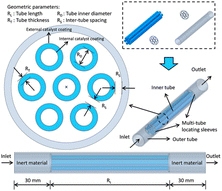
Graphical abstract: Multi-objective optimization design of microchannel reactors for Fischer–Tropsch synthesis using CFD, GENN, and NSGA-II

Supplementary files

Article information

Article type
Paper
Submitted
09 Dec 2025
Accepted
29 Dec 2025
First published
08 Jan 2026
This article is Open Access
Creative Commons BY-NC license

RSC Adv., 2026,16, 2255-2270

Multi-objective optimization design of microchannel reactors for Fischer–Tropsch synthesis using CFD, GENN, and NSGA-II

S. Ren and Y. Wang, RSC Adv., 2026, 16, 2255 DOI: 10.1039/D5RA09551D

This article is licensed under a Creative Commons Attribution-NonCommercial 3.0 Unported Licence. You can use material from this article in other publications, without requesting further permission from the RSC, provided that the correct acknowledgement is given and it is not used for commercial purposes.

To request permission to reproduce material from this article in a commercial publication, please go to the Copyright Clearance Center request page.

If you are an author contributing to an RSC publication, you do not need to request permission provided correct acknowledgement is given.

If you are the author of this article, you do not need to request permission to reproduce figures and diagrams provided correct acknowledgement is given. If you want to reproduce the whole article in a third-party commercial publication (excluding your thesis/dissertation for which permission is not required) please go to the Copyright Clearance Center request page.

Read more about how to correctly acknowledge RSC content.

Social activity

Spotlight

Advertisements