


 PLATFORM UPDATE:


Unleashing the redox-active mediator effect on the Ni-MOF electrode with a flower-like structure employed for supercapacitor applications
 *b
Abeer
Enaiet Allah
bc
*b
Abeer
Enaiet Allah
bc
Abstract
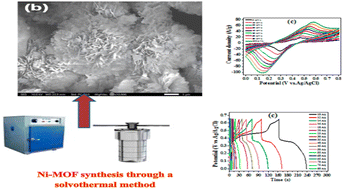
Improving the energy density and performance of a supercapacitor necessitates the use of novel electrode materials and electrolytes that possess long-term stability. The high energy density, pseudocapacitance, and specific capacitance may be conferred by superior electrodes and redox mediator electrolytes used in the practical application of supercapacitors. In this work, the Ni-BDC MOF was synthesized using a solvothermal method, and its potential for use in supercapacitor applications was examined. Its morphology, microstructure, crystalline phase, and functional groups were determined using SEM coupled with EDX, XRD, and FTIR analyses, respectively. In addition, Brunauer–Emmett–Teller analysis was performed to estimate the catalyst's BET surface area and distribution of pore size. The Ni-BDC MOF electrodes' electrochemical performances were estimated using CV, GCD, and EIS techniques in various aqueous electrolytes (1 M KOH, 1 M H2SO4, and 1 M Na2SO4) and a redox electrolyte (1 M H2SO4 + 0.1 M KI). The Ni-BDC MOF electrode exhibited a high specific capacitance (capacity) of 1569.98 F g−1 (852.5 C g−1) at 10 A g−1 current density in a 1 M H2SO4 + 0.1 M KI electrolyte, with a maximum energy density of 64.29 Wh kg−1, maximum power density of 11 600 W kg−1, and remarkable capacitance retention of 125.49% after 1500 GCD cycles at 80 A g−1 current density. Its performance was superior to that in the KI redox electrolyte and conventional KOH, H2SO4, and Na2SO4 electrolytes. The admirable electrochemical performance of the Ni-BDC MOF in the 1 M H2SO4 + 0.1 M KI electrolyte was attributed to the small mass of hydrogen ions (H+).
 Please wait while we load your content...


