


 PLATFORM UPDATE:

Mechanism of action of a boron-dependent antibiotic entails synergistic binding

Abstract
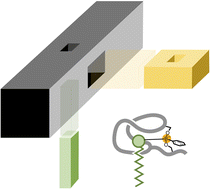
Laspartomycin C (LspC) is a calcium-dependent antibiotic (CDA), a family of peptide antibiotics that has an intriguing mechanism of action (MOA) and great promise in drug development. While it has long been known that CDAs require Ca(II) to function, the mechanistic details remain elusive. We previously reported a synthetic analog of LspC, termed B1, that can be fully activated by phenylboronic acid (PBA) and is no longer dependent upon Ca(II) for its antibacterial activity, providing a new entry point to study the MOA of CDAs. In other words, Ca(II) is the cofactor for LspC activation and PBA is the cofactor for B1 activation. Presented herein is their thorough characterization using isothermal calorimetry, NMR, and molecular dynamics simulation. To our surprise, we found that even though both LspC and B1 sequester isoprenyl phosphate to suppress bacterial growth, they go through distinct paths. LspC and B1 have analogous thermodynamic endpoints, namely, a stable ternary complex containing the peptide antibiotic, the cofactor (Ca(II) or PBA), and the substrate. However, the former goes through a binary complex intermediate, whereas for the latter, there is no detectable interaction between any pairs of the three components (B1, PBA, and the substrate). B1 thus presents an extreme case of synergistic binding and a unique way to control the activity of an antibiotic.
 Please wait while we load your content...


