


 PLATFORM UPDATE:


Imidazolium versus phenylalaninium hybrid salts: supramolecular control of electronic, nonlinear optical and bioactive properties
 *ef
*ef
Abstract
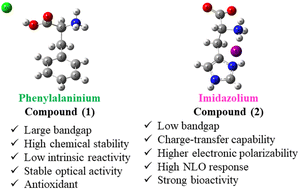
Two new amino-acid-based hybrid salts, L-phenylalaninium chloride (1) and L-histidinium iodide (2), were synthesized and comprehensively characterized to elucidate how cation identity, halide nature, and supramolecular architecture govern their optical, electronic, and biological properties. Single-crystal X-ray diffraction revealed that both compounds crystallize in the non-centrosymmetric P212121 space group but exhibit distinct packing motifs: a compact chloride-stabilized network in (1) and a more open, highly polarized iodide-based framework in (2). DFT calculations show that compound (2) possesses a significantly reduced HOMO–LUMO band gap, higher molecular softness, and enhanced intramolecular charge transfer, leading to a first hyperpolarizability nearly three times larger than that of (1). FT-IR and RDG analyses confirm stronger charge-assisted N–H⋯I interactions in (2), consistent with its superior electronic polarization. Biological assays further demonstrate that compound (2) exhibits markedly enhanced antioxidant and antibacterial activities, attributed to its imidazolium-based charge distribution and iodide polarizability. Together, these findings establish clear structure–property relationships and highlight the effectiveness of combining heterocyclic amino acids with highly polarizable halides to design multifunctional organic–inorganic materials with promising NLO and bioactive potential.
 Please wait while we load your content...


