


 PLATFORM UPDATE:


Bio-inspired synthesis of Co-doped iron oxide nanoparticles using Ocimum tenuiflorum extract for enhanced oxygen evolution reaction

Abstract
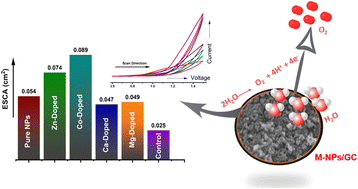
Meeting the energy demands of modern society remains a significant issue in pursuing safe, sustainable, and highly effective fuel generation. The oxygen evolution reaction (OER) is a contemporary method for hydrogen production and many novel electrocatalysts have been explored recently to enhance the efficiency of O2 evolution. This study focuses on: (i) the green synthesis of iron oxide nanoparticles (NPs) using the leaf extract of Ocimum tenuiflorum; (ii) doping with transition/alkaline earth metals (Co, Zn, Mg, and Ca); and (iii) their OER potential. The NPs were characterized in detail via Fourier-transform infrared spectroscopy (FTIR), scanning electron microscopy (SEM), X-ray diffraction (XRD), UV-visible spectroscopy, and square wave voltammetry (SWV), all of which confirmed the successful formation of these NPs. A glassy carbon electrode modified with NPs was used to evaluate OER potential. The Co-doped NPs attained a high electrochemically active surface area (ECSA) of 0.089 cm2, which also coincides with a high intrinsic activity attained via a Tafel slope of 58 mV dec−1 and turnover frequency (TOF) up to 0.38 s−1. Among all variants, Co-doped nanoparticles exhibited superior electrocatalytic performance with the lowest Eonset, demonstrating their potential as an efficient and sustainable OER catalyst. This study underscores the potential of plant extract mediated approaches to synthesise NPs for application in energy conversion and storage devices.
 Please wait while we load your content...


