


 PLATFORM UPDATE:


pH-driven spontaneous recovery of tyrosine via co-precipitation in the indirect aqueous carbonation of gypsum
 *ab
*ab
Abstract
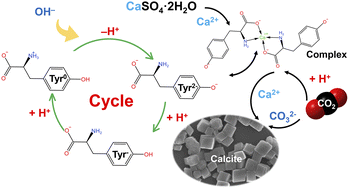
Efficient recycling of leaching additives is crucial for the economic viability of indirect aqueous carbonation of gypsum. This study presents a pH-driven spontaneous co-precipitation strategy employing tyrosine (Tyr) as a recyclable additive. The method exploits the inherent pH decrease during carbonation to spontaneously precipitate and separate Tyr from the SO42−-rich carbonation mother liquor. In a strongly alkaline medium, fully deprotonated Tyr chelates with Ca2+, significantly enhancing the solubility of CaSO4·2H2O. Response surface methodology based on a Box–Behnken design was applied to optimize the leaching conditions, which were determined as follows: Tyr/CaSO4·2H2O = 5.51 mol mol−1, KOH/Tyr = 2.00 mol mol−1, and liquid-to-solid ratio = 51.38 mL g−1. Under these conditions, the leached Ca2+ concentration reached 16.09 ± 0.30 g L−1—six times higher than the solubility of CaSO4·2H2O in pure water at 30 °C (∼2.6 g L−1). During the early stage of carbonation, the Ca2+–Tyr complexes dissociate as the pH decreases, releasing free Ca2+ for direct precipitation of homogeneous calcite, while neutral Tyr0 co-precipitates efficiently. Under the optimized carbonation conditions (30 °C, CO2 flow rate 150 mL min−1, 50 min), the carbonation efficiency and Tyr recovery efficiency exceeded 97% and 95%, respectively. The process also demonstrated excellent stability over five leaching–carbonation cycles, with average values of 12.63 ± 0.56 g L−1 for Ca2+ leaching concentration, 93.41 ± 1.85% for carbonation efficiency, and 92.73 ± 0.52% for Tyr recovery efficiency.
 Please wait while we load your content...


