


 PLATFORM UPDATE:

Facilitating the Fe(iii)/Fe(ii) redox cycle with organic pollutants to enhance the heterogeneous Fenton-like catalytic performance of iron-containing catalysts
 *a
Wenchao
Yang,
a
*a
Wenchao
Yang,
a
Abstract
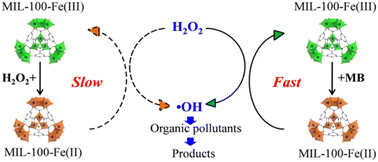
The heterogeneous Fenton-like reaction is a promissing technology for removing organic pollutants in water. The reduction of Fe(III) to Fe(II), as the rate-limiting step for generating ˙OH, is crucial in heterogeneous Fenton-like reactions and may be improved using organic pollutants with lower redox potential than that of Fe(III)/Fe(II). In this work, the rapid reduction of Fe(III) to Fe(II) on the MIL-100-Fe catalyst was achieved by degrading methylene blue (MB, E0 = 0.01 V), which has the desired lower redox potential than that of MIL-100-Fe(III)/Fe(II) (E0 = 0.76 V). By contrast, organic pollutants with higher redox potentials than that of MIL-100-Fe, such as phenol (E0 = 0.97 V) and p-nitrophenol (E0 = 1.23 V), were incapable of reducing Fe(III) to Fe(II). As a result, the degradation rate constant of MB was one order of magnitude higher than those of phenol and p-nitrophenol. Notably, MB could also promote the reduction of Fe(III) to Fe(II) in the presence of phenol or p-nitrophenol; thus, the degradation rate constants of phenol and p-nitrophenol were significantly enhanced by 50 and 30 times, respectively. The results revealed that organic pollutants with lower redox potential than that of Fe(III)/Fe(II) could facilitate the reduction of Fe(III) to Fe(II), which is beneficial for producing more ˙OH, thus improving the heterogeneous Fenton-like catalytic performance.
 Please wait while we load your content...


