


 PLATFORM UPDATE:


Molecular mechanism of biocompatible clusteroluminogens from citric acid and l-lysine
 *b
and
Baohui
Li
*a
*b
and
Baohui
Li
*a
Abstract
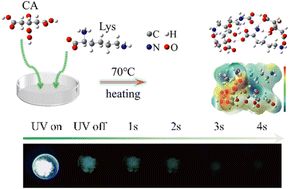
Clusteroluminescence in non-conjugated systems has garnered significant attention for the development of advanced light-emitting materials, however, the understanding of the underlying mechanism remains a challenge. Herein, we report a facile, one-step strategy to prepare unconventional dual-mode luminescent materials by thermal treatment of aqueous citric acid (CA) and L-lysine (Lys). These materials exhibit bright fluorescence (The quantum yield is up to 43.2%) and remarkably long-lived room-temperature phosphorescence (RTP, up to 5 s). Combined experimental characterization and theoretical calculations were used to reveal the underlying dual emission mechanisms. Theoretical calculations revealed a reduced HOMO–LUMO energy gap upon blending of the CA and Lys and formation of ionic interaction in CA and Lys mixtures. Blue IRI isosurface calculation demonstrates the formation of H⋯O and H⋯N intermolecular weak interactions, which promote efficient electron transitions, enhancing molecular excitability. This structural characteristic increases the probability of radiative decay to the ground state, thereby improving long-wavelength fluorescence efficiency. The observed trends in fluorescence and phosphorescence spectra were in excellent agreement with theoretical calculation results, providing further mechanistic insights into the luminescence behavior. This work provides a facile strategy for the preparation of dual-mode luminescent materials and new insight into understanding the molecular mechanism of clusteroluminescence in non-conjugated systems.
 Please wait while we load your content...


