


 PLATFORM UPDATE:


Thermal shock resistance of various two-dimensional materials: a comparative analysis
 *b
and
Nader
Malih
c
*b
and
Nader
Malih
c
Abstract
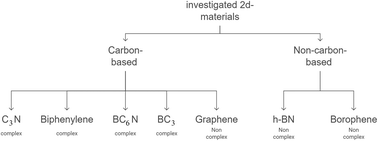
Understanding the ultrafast thermomechanical response of two-dimensional (2D) materials is crucial for their integration into next-generation nanoelectronic and thermal management technologies. In this study, molecular dynamics simulations are used to systematically evaluate the thermal shock resistance of graphene, C3N, BC3, three BC6N configurations, biphenylene, borophene, and hexagonal boron nitride (h-BN). A localised, rapid temperature increase is applied to generate stress waves, enabling direct assessment of wave-propagation velocity, decay rate, energy dissipation, atomic displacement, and temperature changes in both armchair and zigzag orientations. The findings reveal strong correlations between lattice topology and non-equilibrium thermomechanical behaviour. Graphene and C3N show exceptional shock tolerance, with high wave speeds and minimal attenuation; C3N demonstrates nearly undamped propagation. Borophene exhibits notable anisotropy, with wave transmission and dissipation depending on direction, whereas biphenylene and BC3 exhibit significant damping and stress irregularities due to their structures. The trends highlight how thermal shock resistance depends on bonding structure, coordination, and lattice symmetry. This work provides a unified benchmark for transient thermal-mechanical performance in 2D materials and offers valuable guidance for selecting and designing atomically thin systems for high-thermal-demand applications.
 Please wait while we load your content...


