


 PLATFORM UPDATE:


How topology governs cation affinity: protonation and metal coordination in 1- and 9-azahomocubane
 *a
and
*a
and
Abstract
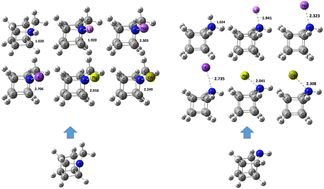
The interaction of cationic species with aza-homocubanes provides a powerful platform for probing the effects of cage topology on electronic structure and noncovalent binding phenomena. Here, density functional theory (DFT) calculations were employed to investigate the complexation of 1-azahomocubane and 9-azahomocubane with H+, Li+, Na+, K+, Mg2+, and Ca2+. Optimized geometries reveal systematic trends in cation–nitrogen bond distances, with protonation yielding short covalent-type N–H+ interactions (∼1.0 Å), alkali metals displaying increasing separation with ionic radius (N–Li ≈ 1.9 Å, N–Na ≈ 2.3 Å, N–K ≈ 2.7 Å), and alkaline earth dications forming significantly shorter and stronger bonds than size-comparable alkali cations (N–Mg2+ ≈ 2.0 Å vs. N–Na ≈ 2.3 Å). Analysis of Hirshfeld charges confirmed substantial electron transfer from nitrogen to the bound cation, with the charge on N shifting from −0.134e in free 1-aza to +0.067e upon protonation, and from −0.163e in free 9-aza to +0.058e in its protonated form. For metal complexes, the nitrogen charges became even more positive, e.g., −0.141e → +0.666e in (1-aza + Li)+ and −0.158e → +0.663e in (9-aza + Li)+, highlighting significant charge redistribution. The cation affinity (CA) and CB (cation basicity) indices quantified the stabilization: for instance, CA/CB values of 48.84/41.50 kcal mol−1 were obtained for (1-aza + Li)+ compared to 46.13/38.91 kcal mol−1 for (9-aza + Li)+, confirming stronger binding in 1-aza. The non-covalent interaction (NCI) isosurfaces and reduced density gradient (RDG) profiles revealed localized covalent-like interactions for protonated species, while alkali metals exhibited more diffuse electrostatic contacts, with dications displaying highly concentrated interaction regions. Collectively, the results reveal subtle but systematic differences between the two isomers, with 1-azahomocubane often exhibiting slightly shorter interaction distances and marginally enhanced stabilization relative to 9-azahomocubane, highlighting the influence of nitrogen topology on cation binding.
 Please wait while we load your content...


