


 PLATFORM UPDATE:


Ascorbic acid-mediated solid-state synthesis of cavity-engineered CuO–Cu2O–Cu heterostructures: structural transformation mechanism and photocatalytic detoxification of Cr(vi)
 *a
and
Mostafa Y.
Nassar
*b
*a
and
Mostafa Y.
Nassar
*b
Abstract
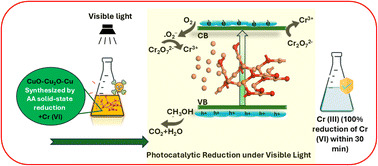
The discharge of toxic Cr(VI) into water presents environmental health hazards, requiring efficient, sustainable photocatalysts for its reduction to Cr(III). In this work, a simple, environmentally friendly solvent-free solid-state route was developed to synthesize CuO–Cu2O–Cu heterostructures, where the novel use of solid ascorbic acid (AA) as a green reductant enables both the solid-state formation of Cu species and controlled reduction of CuO to Cu2O and Cu by adjusting the AA amount. Structural analyses confirmed the coexistence of Cu, Cu2O, and CuO phases, while FESEM and HRTEM revealed cavity-like core–shell architectures with dense heterointerfaces facilitating charge transfer. The optimized CuO–A1.1 showed a narrower band gap (1.42 eV vs. 1.67 eV for CuO) and a higher Cu+/Cu2+ ratio with oxygen vacancies, boosting its photocatalytic performance. The photocatalytic detoxification of Cr(VI) under visible light showed that all heterostructures were active. The CuO–Cu2O–Cu sample prepared by reducing 1 g of CuO with 1.1 g of ascorbic acid (CuO–A1.1) was the most efficient. It achieved complete Cr(VI) reduction within 30 min. Its pseudo-first-order rate constant was 0.1036 min−1, which is nearly 50 times higher than that of pristine CuO (0.0021 min−1). OFAT screening identified pH, Cr(VI) concentration, and catalyst dosage as key factors. One-way ANOVA with Tukey's test showed that pH (F = 762.06, p < 0.0001, R2 = 0.9965) and concentration (F = 92.46, p < 0.001, R2 = 0.97) significantly affected reduction efficiency, while catalyst dosage showed no significant effect (p > 0.05). Levene's test confirmed variance homogeneity, validating the results. Radical scavenging confirmed electrons and ˙O2− as key reactive species. Post-reaction XPS analyses and EPR measurements verified the proposed mechanism in which interfacial charge transfer among Cu, Cu2O, and CuO promotes electron migration and suppresses recombination. These results establish CuO–Cu2O–Cu heterostructure photocatalysts for Cr(VI) reduction and provide mechanistic insights into phase–function relationships in copper oxide.
 Please wait while we load your content...


